A mystery box is a fixed-price purchase where the item you receive is drawn at random from a published pool. You can see every possible outcome and its odds before you buy. You cannot know which one you will get. "Loot box", "case" and "crate" all describe the same mechanic, and the difference between them is branding rather than maths.
What follows is how an opening actually works, what sits in the pool, how the odds are set, and what to check on any site before you spend anything.
What is a mystery box, exactly?
Strip away the presentation and every mystery box site runs the same model. A box has a price, a fixed list of possible items, and a stated probability for each one. You pay the price, the site generates a random outcome inside those probabilities, and you receive whatever it lands on.
Three properties define the mechanic, and a site missing any of them is doing something else:
- The pool is published. Every item that can come out is listed before you open.
- The odds are published per item. Not "fully random" as a slogan, but a number next to each entry.
- The price is fixed. What you pay does not change based on what you are about to receive.
How does opening a case work?
The sequence on Upgrader is short, and the outcome is generated the moment you open:
- Create an account with email, Google or Steam.
- Add funds by card, PayPal or cryptocurrency.
- Pick a box. Browse the boxes by category or by price and read its item list first.
- Open it. The result is generated and shown immediately, with no waiting period.
- Redeem it. Ship the physical item, or take its value in cryptocurrency.
There is no step where a person reviews your result. That matters more than it sounds, and the provably fair section below explains why.
What is actually inside the boxes?
This is where mystery box sites differ most, and where the category name is least helpful. Many sites in this space stock in-game items, mainly CS2 and Rust skins. Upgrader's boxes are stocked with physical goods: sneakers, consumer tech, watches and luxury pieces.
As of August 2026 the official catalogue is 291 boxes drawing on roughly 2,600 distinct items, including 133 separate Jordan listings, 83 Nike and 62 Yeezy. Broken down by where the items come from:
| What it is | Examples | Distinct items |
|---|---|---|
| Sneakers, resale-sourced | Jordan, Nike, Yeezy, New Balance | 854 |
| Consumer tech | MacBook Air, Mac mini, iMac, AirPods, peripherals | 355 |
| Watches and luxury | Rolex, designer accessories | 49 |
| Hand-listed, everything else | Dior sneakers and jewellery at the top end, cars and jet skis as headline prizes, stickers and shoe laces as filler | 1,334 |
That last row deserves the plain reading. A large share of any box's item list is deliberately low-value filler, and those are the entries with the high probabilities attached. The headline item in the picture is the rare one. Reading the odds column next to each entry is how you tell which is which. Trading filler you never wanted for a shot at something you did is what item upgrading is for, and it carries a margin of its own worth understanding before you use it.
Stocking physical goods also makes redemption a real logistics step rather than an inventory transfer. A digital item moves in seconds. A pair of sneakers has to be picked, packed and shipped, which is why the withdrawal page asks for a delivery address and why shipping is limited to supported countries. Taking the value in cryptocurrency instead settles the same day.
How do mystery box odds work?
The odds attached to a box tell you the probability of each specific item in it. Add every item's percentage together and the total is 100%, because exactly one outcome happens per opening.
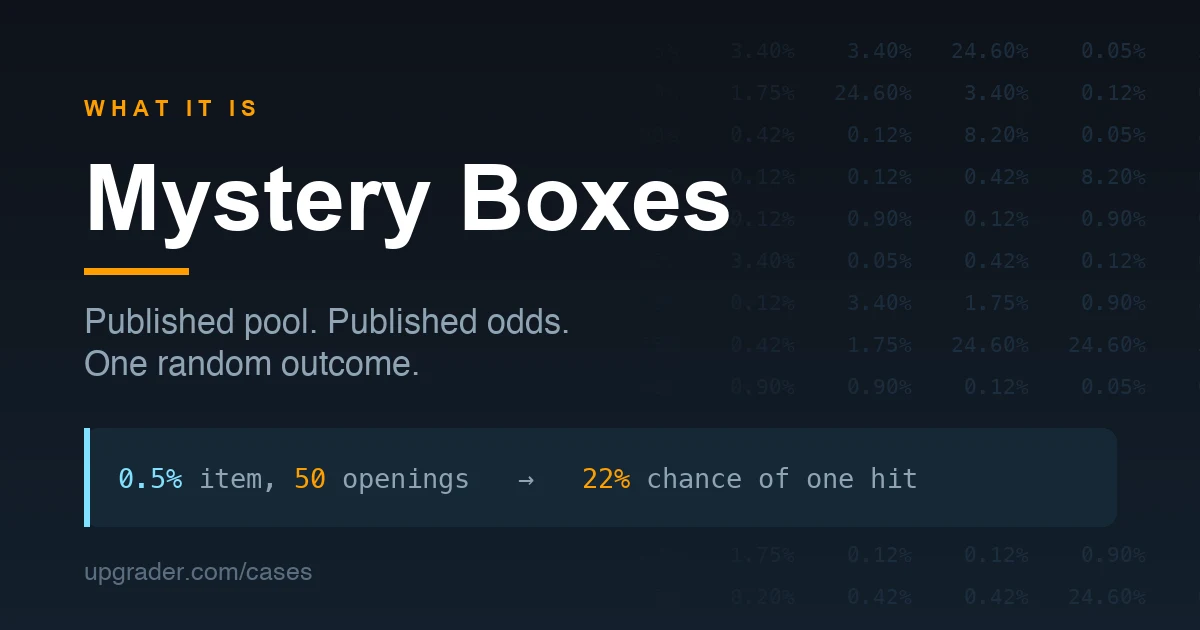
The part that costs people money is a misreading of independence. If an item has a 0.5% chance, it has a 0.5% chance on your first opening and a 0.5% chance on your fiftieth. It is never "due". Fifty openings that missed it do not make the fifty-first more likely, because the box has no memory of the previous rounds. Across 50 openings at 0.5% each, the chance of seeing that item at least once is about 22%, which means missing it entirely is the ordinary result rather than bad luck.
What separates a site worth using from a vague one is whether you can read that table item by item before you open, rather than being told the system is fair in marketing copy.
Are mystery boxes worth it?
For most single openings, no, and the honest version of that answer is worth more than a sales pitch. The pricing model across this entire category, Upgrader included, sets the box price above the average value of its contents. That gap is how the business is funded. It means the expected result of any one opening is a loss.
The useful comparison is not an investment. It is closer to a raffle: you are paying a known amount for a chance at an outcome larger than your stake, with the odds visible in advance. That can be reasonable entertainment spend and it is a poor savings plan. Two things follow:
- Read the odds table before you open, not after. It is the one input that turns the decision from a guess into an informed one.
- Only spend money you are content not to get back. Every mystery box carries a real chance of receiving less than you paid.
Why does provably fair matter here?
A published odds table only means something if the site cannot quietly pick your outcome after seeing what you spent. Nothing in an odds table prevents that on its own, because the table is not proof of where the result came from.
Provably fair closes that gap. The site commits to a secret before the round by publishing its hash, mixes in an input it does not control, then reveals the secret afterwards so anyone can recompute the outcome and confirm it was not altered. Our full breakdown, including the exact formulas used for solo games and for multiplayer modes like Battles, is in provably fair, explained.
The reason to care as a buyer is narrow and practical: it is the only feature in this category that you can verify yourself instead of trusting.
What should you check before opening your first box?
- An item-by-item odds table on the box page itself, not a general claim that outcomes are random.
- A provably fair system you can actually run, with the seeds and the method published, not a badge.
- Stated terms for physical prizes: what happens if an item is delayed, damaged or out of stock, and which countries it ships to.
- A visible age requirement and responsible play policy. If you cannot find one in two minutes, that is the finding.
Those checks are worth running on any site, us included. We put Upgrader through them, along with the payout record and the limits of what can be verified at all, in is Upgrader legit.
Common questions
Is a mystery box the same as a loot box?
Yes. "Mystery box", "loot box", "case" and "crate" are different names for one mechanic: a fixed-price purchase with a randomised outcome drawn from a published pool. "Loot box" is used more often for in-game items and "mystery box" more often for physical goods, but the underlying model is identical.
Can you improve your odds?
Not within a box. Each opening is independent and random inside the published probabilities, so no pattern of timing, staking or repetition changes the chance of any single result. The only real choice you control is which box you open and what its odds table looks like.
Can you lose everything you spend?
Yes. Most outcomes in most boxes are worth less than the box price, and a run of them can consume a balance entirely. This is the expected behaviour of the model, not a malfunction.
Do you actually receive the physical item?
Yes, or its value in cryptocurrency if you prefer. Physical redemption goes through the withdrawal page, needs a delivery address in a supported country, and takes as long as shipping takes. Import duties are the recipient's responsibility in most destinations.
Is this gambling?
Upgrader operates as a sweepstakes platform, with game modes that are free to enter alongside paid entry, and it is restricted to users aged 18 or over. How the mechanic is classified depends on where you live. The terms of service set out the model, the age requirement and the eligibility rules in full.