Upgrader is a live platform that publishes its odds, lets you recompute your own results, and has settled 134,989 withdrawals to 11,720 different accounts since January 2025. That is the useful answer, because "legit" is not one property. It breaks into four separate claims, and you can check three of them yourself without taking our word for anything.
Below is each claim, how to test it here, and the places where verification genuinely runs out.
What does "legit" actually mean for a mystery box site?
The word gets used for four different questions that have four different answers:
- Is the draw honest? Was the outcome fixed before you opened, or chosen afterwards?
- Are the odds real? Does the published table match what the system actually rolls?
- Do prizes arrive? Does a win become an item in your hands or money in your wallet?
- Is the pricing fair? Is what you paid reasonable against what the box contains?
A site can pass the first three and still be expensive on the fourth. Any operator claiming all four are beyond question is selling, not explaining. The first three are testable. The fourth is a judgement you have to make, and we come back to it at the end.
Can you verify the draw yourself?
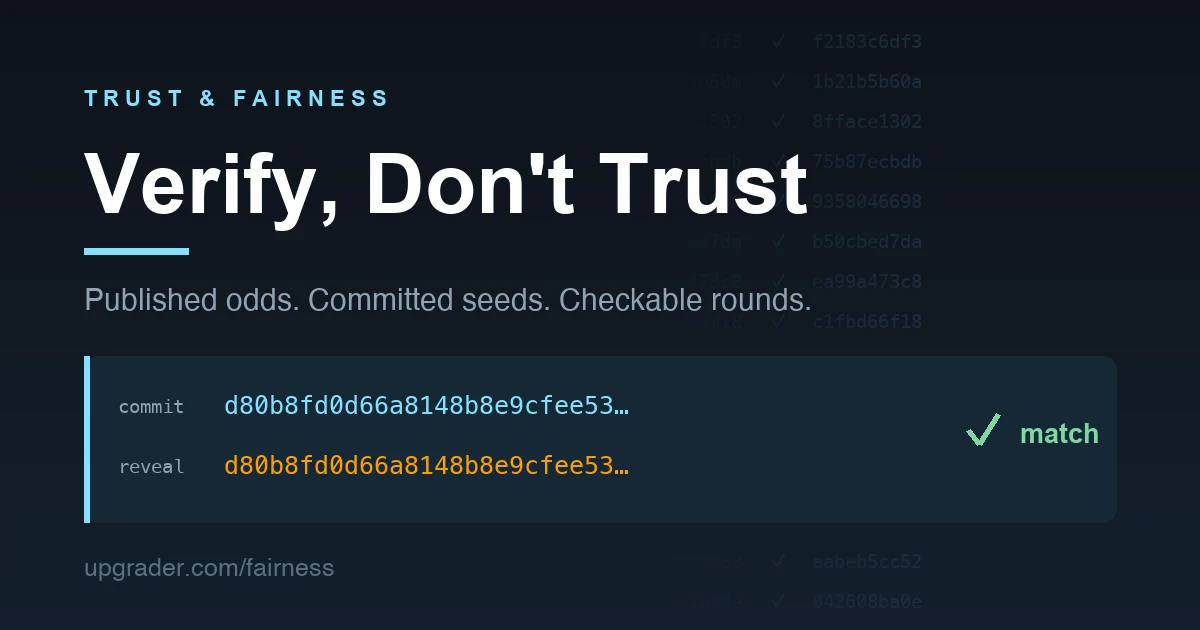
Yes, and this is the part that separates a checkable site from a confident one. Before a round runs, the server commits to a secret by publishing its hash. Your own input goes into the mix. Afterwards the secret is revealed, and anyone holding those pieces can recompute the outcome and confirm it was not altered.
The practical test is that the fairness page carries a working verifier, not a description of one. You paste in the server seed, client seed and nonce from a round you actually played and it recomputes the result in front of you, for cases, deals, upgrading, mines, keno, battles, coinflip, jackpot and crash. If the number it returns matches what you received, that round was not touched.
The mechanism, including the exact formulas and what each input does, is written up in full in provably fair, explained. The short version of why it matters: a rigged random number generator is not the realistic attack. Choosing your outcome after seeing your balance is. A commitment published in advance is what makes that impossible rather than merely discouraged.
Are the odds published before you open?
Every one of the boxes lists its contents item by item with a probability against each one, visible before you spend anything, and those probabilities total 100%.
Read that table rather than the artwork. A meaningful share of any box's item list is deliberately low-value filler, and those entries carry the high probabilities. The headline item is the rare one. That is not a trick, it is how the pricing works on every site in this category, but it is only obvious if you look at the column instead of the picture. What is a mystery box sets out the pool, the pricing model and how to read an odds table properly.
Do prizes and payouts actually arrive?
This is the claim most sites assert and few quantify, so here is the number: 134,989 settled withdrawals to 11,720 separate accounts between January 2025 and August 2026. Cryptocurrency withdrawals settle the same day.
Physical items are a slower path because they are real objects. Redemption runs through the withdrawal page, needs a delivery address in one of the supported countries, and then takes as long as shipping takes. Import duties fall to the recipient in most destinations. If a site does not tell you which countries it ships to before you win something, that is worth knowing in advance rather than afterwards.
You can also test the payout path without depositing. Free-entry boxes have been opened more than 355,000 times, and the sweepstakes model they run under is set out in the terms of service.
Where does verification stop?
Being straight about the limits is more useful than another reassurance, and these are real:
- Provably fair proves the draw, not the value. It confirms the roll was honest. It says nothing about whether the item you won was priced sensibly, or whether the box was worth its cost. The same split applies to item upgrading, where the cost sits inside the win chance rather than in a visible fee.
- Item valuations are ours, not an independent appraisal. Resale prices move. A figure attached to an item is a reasonable estimate at a point in time, not a promise of what it will sell for.
- The expected result of an opening is a loss. Box prices sit above the average value of the contents, which is how the business is funded. No verification changes that, and any site implying otherwise is misleading you.
- Shipping depends on couriers and customs. Neither is under our control once a parcel leaves.
A platform that will state those four things plainly is giving you more to work with than one that answers every question with the word "fair".
What protections does the account have?
Accounts are restricted to users aged 18 or over. Self-exclusion is available for anyone who wants to close off access to their own account. Anti-money-laundering procedures and the full eligibility rules are published rather than summarised, and logins carry a verification step before a session is trusted.
How to check any site, including this one
Apply these to us and to whoever else you are considering. They are deliberately mechanical, because criteria travel better than opinions:
- Open a box page without an account. Can you see every item and its individual probability?
- Find the fairness page. Is there a verifier you can run, with the algorithm stated, or only a badge?
- Take a round you played and recompute it. Does the result match?
- Find the shipping countries and the delayed-or-damaged policy before you win, not after.
- Look for the age limit and a self-exclusion route. If neither is findable in two minutes, that is the finding.
- Check whether the site will state its own downside anywhere. Ones that never do are the ones to be careful with.
A site failing several of these is not proof of dishonesty, and we are not going to tell you which competitors to avoid. It does mean you would be trusting rather than checking, and on money that is a worse position to be in.
Common questions
Is Upgrader a scam?
No. It is an operating platform with published per-item odds, a verifier that lets you recompute your own rounds, and a settled-withdrawal record of 134,989 payouts to 11,720 accounts since January 2025. Whether it is good value for you is a separate question, and the answer depends on treating it as entertainment spend rather than a way to make money.
How do I verify one specific round?
Take the server seed, client seed and nonce from the round in your history, put them into the fairness page verifier, and compare the result it computes with the item you received. A step-by-step walkthrough is in provably fair, explained.
Can I lose money?
Yes. Most outcomes in most boxes are worth less than the box price, and a sequence of them can empty a balance. That is the expected behaviour of the model rather than a malfunction, and it is why the only sensible amount to spend is one you are content not to get back.
Do I have to deposit to open anything?
No. Free-entry boxes exist and have been opened more than 355,000 times, which also makes them a reasonable way to see how the mechanic and the redemption path behave before spending.
Is this gambling?
Upgrader operates as a sweepstakes platform with both free and paid entry, restricted to users aged 18 or over. How the mechanic is classified depends on where you live, and the terms of service set out the model, the age requirement and the eligibility rules in full.