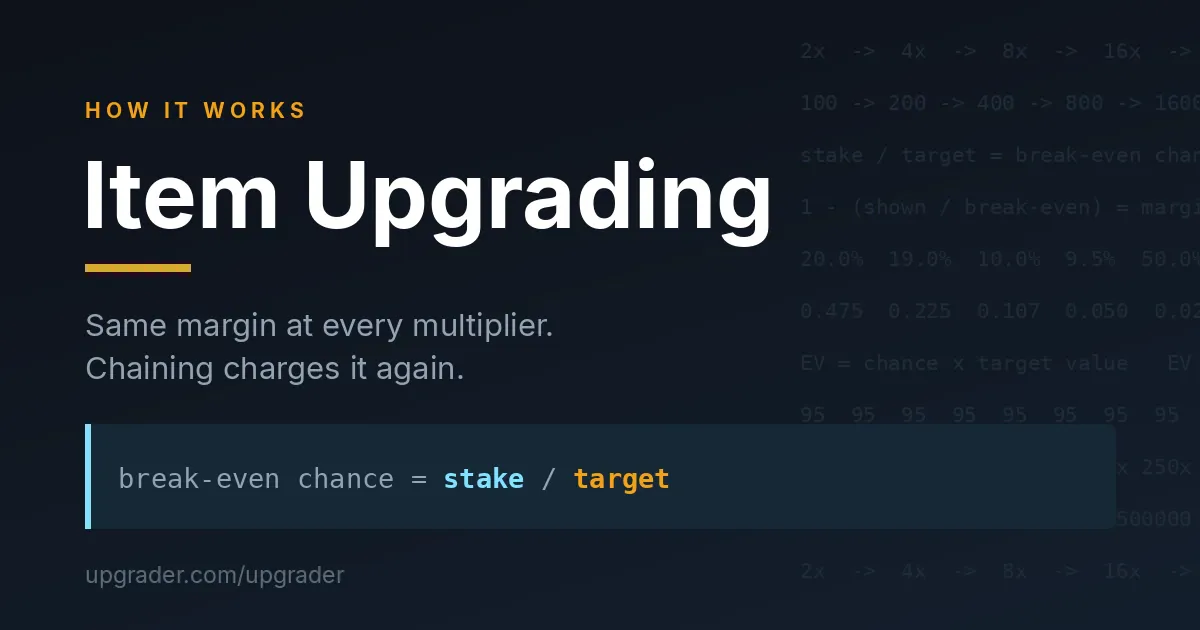
Item upgrading is a trade with published odds: you stake something you own, name something worth more, and the site shows you the chance of the swap succeeding before you commit. Win and the target item is yours. Lose and the staked item is gone. There is no partial outcome.
The mechanic is simple. The arithmetic underneath it is where people lose money without noticing, because the cost is not charged as a fee. It is folded into the win chance. What follows is how to read that number, why picking a bigger multiplier does not do what most people assume, and the one habit that quietly costs the most.
How does an upgrade work?
Four steps, and the outcome is fixed the moment you confirm:
- Pick what you are staking. An item you already hold, or balance.
- Pick your target. Something worth more. The ratio between the two is the multiplier.
- Read the chance. The site displays your win probability before you confirm. This is the only number that matters, and the next section is about what to compare it against.
- Confirm. The result is generated immediately. Success hands you the target item. Failure takes the stake.
Like the boxes, an upgrade is a solo game, so the result comes from the same committed inputs: your client seed, our server seed, and a nonce. It is fixed before the site knows anything it could act on, and you can recompute it afterwards on the fairness page. Provably fair, explained covers the mechanism and the exact formulas.
Where the margin actually sits
Start with what a break-even upgrade would look like. If you stake $100 against a $500 target, a trade with no margin in it would succeed 20% of the time, because $100 is one fifth of $500. Over many attempts you would end up roughly where you started.
No site offers that, and none can. The displayed chance is always a little below the break-even figure, and that gap is the entire business model of the feature. It is not disclosed as a percentage fee anywhere on the screen, which is exactly why it is worth learning to read.
You can compute it yourself from two numbers the interface already gives you:
break-even chance = stake value ÷ target value
implied margin    = 1 − (displayed chance ÷ break-even chance)
Staking $100 at a $500 target with 19% shown: break-even is 20%, so the implied margin is 1 − (0.19 ÷ 0.20), or 5%. Every $100 you put through that trade returns $95 on average. Every figure below uses that illustrative 5% to keep the arithmetic legible. Read the real one off your own screen before you trade, using the two lines above.
Does a bigger multiplier give you better value?
No, and this is the most common misreading of the feature. The multiplier changes how the outcome is shaped, not what it is worth.
Three trades on the same $100 stake, all at a 5% margin:
| Multiplier | Target value | Break-even chance | Chance shown | Average return |
|---|---|---|---|---|
| 2× | $200 | 50% | 47.5% | $95 |
| 5× | $500 | 20% | 19% | $95 |
| 10× | $1,000 | 10% | 9.5% | $95 |
The average return is identical because the margin is a percentage of what you stake, and you staked the same amount in all three. What changes is the distribution. At 2× you win about half the time and the swings are small. At 10× you lose nine attempts in ten, and the tenth carries everything.
So multiplier choice is a question about how much variance you want to absorb, not about which trade is priced better. Anyone recommending a specific multiplier as the smart one is selling a preference as a strategy.
Why chaining upgrades is worse than one big one
The habit that costs the most is the ladder: take a small item, upgrade it to a medium one, upgrade that to a large one, and keep climbing. It feels like progress because each individual step has a friendly-looking chance. The problem is that the margin is charged again at every step.
Five successive 2× upgrades and one single 32× upgrade both end at the same place, 32 times your stake. They are not the same trade:
- Five chained 2× upgrades at 47.5% each: 0.4755 ≈ 2.42% chance of completing the ladder.
- One 32× upgrade at 2.97%: 2.97% chance.
Same destination, and the ladder is roughly a fifth less likely to get you there. The reason is that keeping 95% of your value five times running leaves 0.955, about 77% — so a shade under a quarter of what you started with is consumed by the route itself, before luck is considered at all.
The general rule is worth remembering because it applies to every version of this feature on every site: each upgrade in a chain is charged separately, so fewer, larger steps cost less than many small ones aimed at the same target.
When is upgrading actually the right move?
There is a real use case, and it is narrower than the interface implies.
A meaningful share of what any box produces is deliberate low-value filler — this is covered in what is a mystery box. If you have landed something you have no intention of shipping and would not have bought, its practical worth to you is already close to zero. Trading it for a shot at something you would actually want is a reasonable use of a token you were not going to use, and the margin applies to a value you had effectively written off.
What upgrading is not is a method for recovering losses. Staking a balance you are trying to win back into a trade with a built-in margin makes the expected shortfall larger, not smaller. Every step of a ladder run for that reason charges the margin again on money that is already down.
What upgrading does not do
- It does not improve your odds. The displayed chance is the chance. There is no timing, streak or sequence that moves it, because each trade is independent of the last.
- Verifiable is not the same as profitable. You can recompute any upgrade you made and confirm it was honest. That proves the draw, not the price. A verified trade at a poor ratio is still a poor ratio.
- Item valuations are estimates. Both sides of the trade are priced against resale values that move. The multiplier is only as meaningful as the two valuations it sits between.
- The expected result is a loss. Across enough upgrades, the margin is what you have paid for the entertainment. That is the model working as designed, not a malfunction.
Those limits are the same ones that apply to the boxes themselves, and we set out what can and cannot be checked across the whole platform in is Upgrader legit.
Common questions
Can you verify an upgrade result?
Yes. Upgrading uses the same committed seeds as cases, deals, mines and keno, so the outcome is determined before you confirm and can be recomputed from the server seed, client seed and nonce once you rotate your seed. The step-by-step is in provably fair, explained, and the verifier is on the fairness page.
What happens to the item if the upgrade fails?
It is gone. An upgrade is an all-or-nothing trade, not a partial exchange, and there is no consolation return on a failed attempt. This is why the only sensible thing to stake is something you would not mind losing outright.
Is there a best multiplier?
No. Low and high multipliers carry the same margin and therefore the same average return on the same stake. The difference is variance: low multipliers win often and small, high multipliers rarely and large. Pick by how much swing you want, not by which looks like better value.
Does changing my client seed help?
It changes which results you get, not how likely they are. Its purpose is to make it impossible for outcomes to have been prepared in advance for a seed you had not chosen yet, which is a fairness guarantee rather than an advantage.
Can I upgrade balance instead of an item?
Yes, and the arithmetic is identical either way. The break-even chance is still your stake divided by the target value, and the displayed chance still sits below it by the site's margin.